How to Price Crochet Items: The Ultimate Seller’s Guide
If you have ever wondered how to price crochet items fairly — without undercharging or scaring buyers away — you are in the right place. Knowing how to price crochet items is one of the most debated topics in the handmade community, and the vast majority of sellers get it wrong from the very beginning. […]
If you have ever wondered how to price crochet items fairly — without undercharging or scaring buyers away — you are in the right place. Knowing how to price crochet items is one of the most debated topics in the handmade community, and the vast majority of sellers get it wrong from the very beginning.
The most common mistake is comparing handmade goods to mass-produced retail equivalents. A factory-made blanket might sell for $25. Your hand-crocheted version of the same size takes 20 or more hours to complete, uses premium yarn, and carries the unmistakable quality of something made by human hands. These two products are not comparable — and pricing them as if they are is a race to the bottom you simply cannot win.
This guide gives you a complete, professional framework to price crochet items correctly. You will learn how to calculate your true costs, factor in your time at the rate it deserves, account for overhead and profit, and set prices that make your crochet business financially sustainable for the long term — whether you sell finished pieces, digital patterns, or both.
By the end of this article, you will have a clear, tested formula you can apply immediately to every item you make, along with a pricing checklist, quick-reference tables, and actionable answers to the most common pricing questions crochet sellers face.
Why Most Crochet Sellers Struggle to Price Their Items
Before learning how to price crochet items correctly, it helps to understand why so many talented makers consistently underprice their work. The pattern repeats itself across Etsy shops, craft fairs, and Instagram storefronts worldwide, and it almost always comes down to the same three root causes.
Comparing to retail prices: When sellers look at a $30 blanket on Amazon and try to stay competitive with that figure, they have already lost. Handmade crochet does not compete in the mass-market retail space. It competes in the premium, artisan market — where buyers specifically choose your work because it is handmade, unique, and produced with care. Your direct competitors are other skilled crochet sellers, not offshore factories.
Emotional discomfort around charging more: Many crochet sellers feel uncomfortable charging what their time is genuinely worth. This discomfort — often rooted in imposter syndrome or a fear of rejection — leads to chronically low prices that make a sustainable business impossible. Understanding how to price crochet items with confidence is partly a mindset shift, not just a mathematical exercise.
Pricing by instinct rather than formula: Most sellers start by looking at similar items on Etsy, picking a number somewhere in the middle, and hoping for the best. This approach ignores your actual costs, your specific time investment, and your individual overhead. Once you have a reliable, repeatable method to price crochet items, the guesswork disappears entirely.
The goal of correct pricing is not to be the cheapest option in your category. It is to be the right option for buyers who value quality, uniqueness, and handcrafted work — and those buyers exist in large numbers.
The Psychology of Pricing Handmade Crochet
Before diving into the formula, it is worth spending a moment on the psychology of pricing — because how you price crochet items sends a signal to buyers before they even read your product description.
Low prices signal low quality. In the handmade market, buyers who encounter a crochet blanket priced at $35 do not think “great deal.” They think “something must be wrong with it.” Premium buyers — the ones who appreciate handmade goods and are willing to pay accordingly — are actually deterred by prices that feel too low.
Confidence in your price builds buyer confidence. When you price crochet items at their true value and present them professionally, buyers trust that the item is worth what you are asking. Uncertainty in your pricing communicates uncertainty in your product.
Price anchoring works in your favor. If you sell individual patterns at $10 and a bundle of three at $22, the bundle suddenly feels like excellent value. Structuring your products this way — individual items alongside bundles — is a proven strategy for increasing average order value without discounting.
Understanding these psychological principles will help you commit to correct prices even when the number initially feels high. Correct pricing is not arrogance — it is professionalism.
How to Price Crochet Items: The Proven Formula
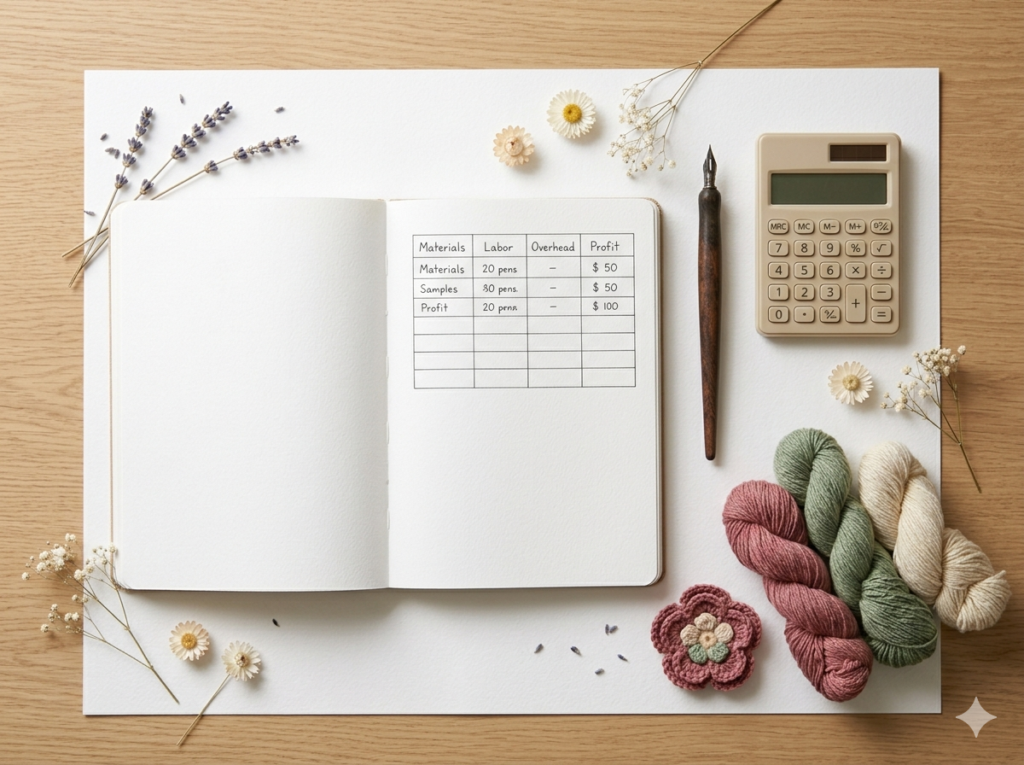
The industry-standard method to price crochet items uses the following formula, trusted by professional handmade sellers across every category:
Selling Price = (Materials Cost × 2) + (Hourly Rate × Hours Worked) + Overhead + Profit Margin
This formula ensures every cost is covered, your time is compensated, your business expenses are absorbed, and you generate profit to reinvest and grow. Let us break down each component in detail.
1. Materials cost — calculate it precisely
The first step when you price crochet items is to determine the exact materials cost for each individual piece. Estimating this figure is one of the most common sources of profit leakage for crochet sellers.
Your materials cost includes:
- Yarn: Do not round up to the nearest skein. Calculate cost per yard by dividing the skein price by its yardage, then multiply by the yards actually used in the project. For example, if a skein costs $8 and contains 400 yards, your cost per yard is $0.02. A project using 350 yards costs $7.00 in yarn.
- Additional fibers: Specialty threads, embroidery floss, wire armatures for amigurumi.
- Notions and hardware: Buttons, zippers, safety eyes, stitch markers, poly-fill stuffing.
- Packaging: Tissue paper, poly bags, branded tags, hang tags, thank-you cards. Every item that leaves your hands and reaches a customer should be accounted for.
- Consumables: A portion of your crochet hook costs, scissors, tapestry needles. While individual hooks last a long time, they do eventually wear out and should be factored in.
The materials are then multiplied by two in the formula. This standard doubling — sometimes called the wholesale multiplier — ensures your materials cost is not only covered but contributes to your overall price at a ratio that reflects the true value of handcrafted goods.
Worked example for a crochet bouquet blanket:
- 14 skeins of yarn at $3.50 each = $49.00
- Packaging and tags = $1.50
- Total materials = $50.50
- Materials × 2 = $101.00
2. Your hourly rate — charge what your time is worth
This is the component where most crochet sellers lose the most money when they price crochet items. Many makers charge $5–8 per hour for their labor — sometimes even less — because charging more feels unjustified or risks making the final price “too high.”
This reasoning is flawed, and it leads directly to financial burnout.
A skilled craft professional’s time has real, documented market value. When you learn how to price crochet items professionally, you must apply a professional hourly rate to your labor. Here are the benchmarks used by established sellers:
- Entry level / beginner seller: Minimum wage in your country or region (at absolute minimum)
- Intermediate seller with a portfolio: $15–25/hour
- Advanced seller with complex techniques: $25–40/hour
- Expert or specialty maker: $40–60/hour or more
If $20/hour feels too high, consider what you would pay a skilled professional to do any other specialized task — a seamstress, a leather worker, a woodworker. Crochet is a skilled craft. It deserves a skilled craft rate.
How to accurately time your projects:
Do not estimate. Time every project from start to finish using a phone timer or a time-tracking app. Include:
- Yarn preparation (winding, untangling)
- The crocheting itself
- Assembly (attaching flowers to a blanket, for example)
- Finishing work (weaving in ends, blocking, trimming)
- Quality checking and photographing
Time the same project type at least twice to get a reliable average. If your rose bouquet blanket consistently takes 24–26 hours, use 25 hours as your benchmark.
Worked example continued:
- 25 hours × $15/hour = $375.00
3. Overhead costs — every business has them
Overhead is the category most often ignored when sellers first learn how to price crochet items — and ignoring it guarantees that your business loses money even when individual sales look profitable.
Overhead covers every business expense that is not directly tied to a specific item but is necessary to keep your shop running:
- Etsy listing fees ($0.20 per listing) and transaction fees (6.5% of sale price)
- Payment processing fees (approximately 3% depending on platform)
- Your own website subscription (Shopify, WooCommerce, Squarespace)
- Domain name renewal
- Email marketing platform subscription
- Shipping supplies (poly mailers, boxes, tape, bubble wrap)
- Photography equipment and props
- Canva or design software subscriptions
- Business cards and marketing materials
- A portion of your home internet or phone bill if used for business
How to calculate overhead per item:
- Add up all business expenses for one month.
- Divide by the number of items you sell or plan to sell per month.
- Add that figure to every item’s price when you price crochet items for your shop.
Example: Monthly overhead of $75 ÷ 20 items sold = $3.75 overhead per item.
As your shop scales and you sell more items, your overhead per item decreases — which is one of the key financial rewards of growing a crochet business.
4. Profit margin — essential for growth
Many sellers confuse profit margin with their hourly wage. They are not the same thing. Your hourly rate compensates your labor. Profit margin is what the business earns above and beyond all costs — and it is what funds your growth.
Profit margin pays for:
- Purchasing larger quantities of yarn at wholesale prices
- Investing in better photography equipment
- Running paid advertisements
- Building inventory for busy selling seasons
- Creating a business savings buffer for slow months
A standard retail markup is 10–30% profit margin added on top of all other costs. For crochet businesses in their first year, 15–20% is a practical and sustainable starting point.
Worked example — completing the formula:
| Component | Calculation | Amount |
|---|---|---|
| Materials × 2 | $50.50 × 2 | $101.00 |
| Labor | 25 hours × $15 | $375.00 |
| Overhead | Monthly costs ÷ items sold | $3.75 |
| Subtotal | $479.75 | |
| 20% Profit margin | $479.75 × 0.20 | $95.95 |
| Final selling price | $575.70 |
This figure surprises many sellers who have been pricing finished blankets at $60–100. But this is the mathematically correct price for a hand-crocheted blanket produced at professional rates. This reality is exactly why so many experienced crochet sellers make the strategic shift toward selling digital patterns instead of — or alongside — finished goods.
How to Price Crochet Items When Selling Digital Patterns
Once you understand how to price crochet items as finished goods, digital patterns reveal themselves as an entirely different — and far more scalable — business model.
Selling a finished blanket earns revenue once. Selling the pattern for that blanket earns revenue every single time someone purchases it, with no additional labor, no materials cost, and no shipping. A pattern you write once in a weekend can generate income for years.
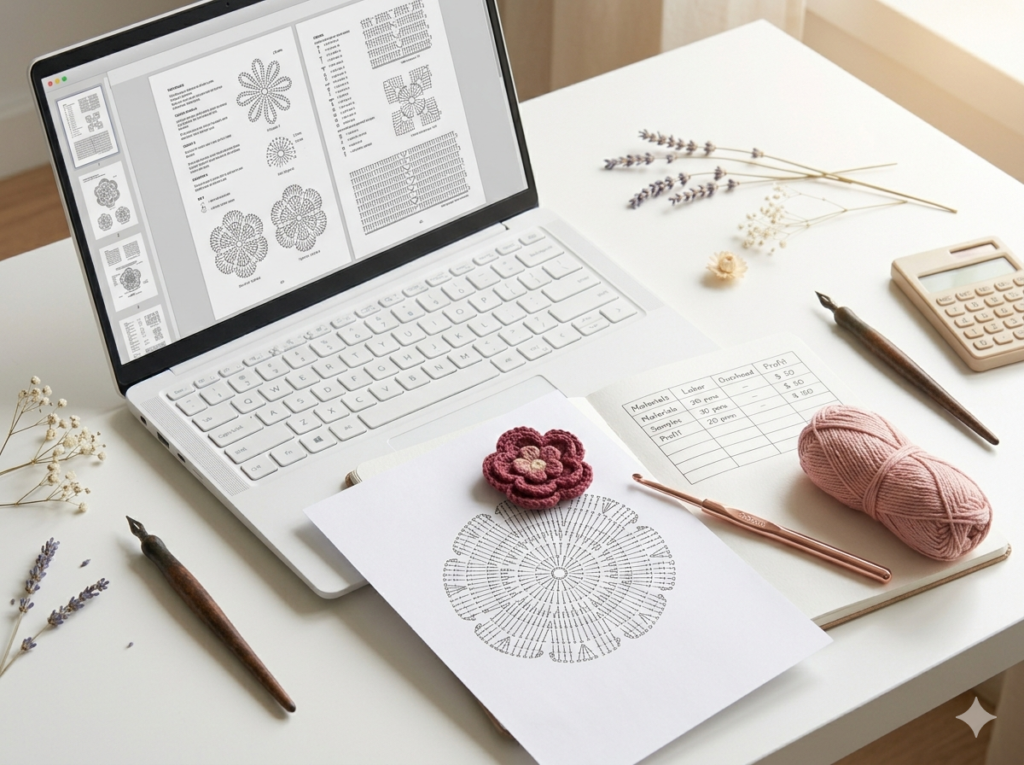
IMAGE PLACEMENT — Place in this section Alt text: “how to price crochet items digital pattern PDF — crochet rose bouquet blanket pattern download”
The digital pattern economics:
- A rose bouquet blanket pattern priced at $10, sold 200 times = $2,000 revenue
- Your materials cost: zero
- Your additional labor cost after writing: zero
- Profit margin: exceptional
To price crochet pattern files, use a different formula:
Pattern Price = (Total creation hours × hourly rate) ÷ Projected sales volume + Desired profit per sale
In practice, most successful pattern sellers use market benchmarking combined with tiered pricing rather than strict formula-based pricing for digital products. Here is the standard pricing tier framework:
| Pattern type | Examples | Price range |
|---|---|---|
| Simple / mini pattern | Single flower, basic coaster | $3–6 |
| Intermediate pattern | Structured accessory, small amigurumi | $6–10 |
| Advanced / signature pattern | Bouquet blanket, complex garment | $10–18 |
| Pattern bundle (3–5 patterns) | Flower collection, seasonal set | $18–30 |
| Comprehensive bundle (5+ patterns) | Full beginner course, large collection | $25–45 |
How to benchmark your pattern prices:
Search Etsy for patterns similar to yours in complexity, photography quality, and included resources. Sort results by “Most relevant” rather than price. Note the price range for the top 10–15 results. Find the median — not the lowest — and position your price at or slightly above it if your patterns include:
- Video tutorial links
- Clear, professional photography
- Abbreviation guides
- Multiple size options
- Metric and imperial measurements
Each of these additions justifies a higher price and reduces buyer hesitation.
How to Price Crochet Items for Different Sales Channels
Knowing how to price crochet items also means understanding that your price may need to adjust depending on where you are selling. Each channel has different fee structures, different buyer expectations, and different competitive landscapes.
Pricing for Etsy
Etsy is the most popular platform for crochet pattern sellers, but it comes with fees that must be factored in when you price crochet items for the platform:
- Listing fee: $0.20 per listing (renews each time an item sells)
- Transaction fee: 6.5% of the total sale price including shipping
- Payment processing: approximately 3% + $0.25 per transaction
- Etsy Ads (if running): varies by daily budget
For a $10 pattern sold on Etsy, total fees are approximately $1.00–1.20. For a $25 bundle, total fees rise to approximately $2.50–3.00. These costs must be included in your overhead calculation — not absorbed as a loss.
Pricing for your own website
Selling through your own website (WordPress with WooCommerce, Shopify, or Squarespace Commerce) gives you significantly more control over your pricing and margin. Platform subscription costs replace transaction fees, and payment processing fees are typically lower than Etsy’s combined fee structure.
For pattern sellers doing significant volume, the migration from Etsy-only to website-primary is often the single most impactful financial decision they make. Retaining an extra 6–8% on every transaction adds up rapidly at scale.
Pricing for craft fairs and local markets
When selling finished crochet items in person, your pricing structure needs to account for:
- Stall or table fees (often $30–150 per event)
- Transportation costs
- Display materials and signage
- Your time attending the event (this is labor — price it accordingly)
Divide your total event costs by your projected sales to determine an additional overhead per item to add when you price crochet items for in-person selling. Many sellers add 15–25% to their standard online price to cover these additional event costs.
Seasonal Pricing Strategy: When to Adjust Your Prices
Experienced sellers who know how to price crochet items also know when to adjust those prices strategically throughout the year.
Peak seasons for crochet sales:
- Christmas (October–December): The single highest-volume period for crochet pattern and finished goods sales. Demand for gifts, seasonal decorations, and holiday projects spikes significantly. This is the appropriate time to introduce limited seasonal bundles at a premium.
- Valentine’s Day (January–February): Flower patterns — including rose and carnation bouquet blankets — see elevated demand as buyers seek handmade romantic gifts.
- Spring/Easter (March–April): Lightweight patterns, flower motifs, and pastel colorways drive traffic. Strong period for flower pattern bundles.
- Back to school (August–September): Surprisingly strong period for pattern sales as people return to indoor hobbies.
When to run sales (and when not to):
Sales and discounts can drive volume in slow periods, but they must be used carefully. Frequent discounting trains your audience to wait for a sale before buying, and it signals that your regular price is not the real price. A better approach is to create genuine limited-time value — such as a seasonal bundle that only exists for a specific period — rather than discounting your core products.
7 Common Mistakes When You Price Crochet Items
Learning how to price crochet items correctly also means learning what to avoid. These are the seven most common pricing mistakes that keep talented makers from building profitable businesses.
1. Pricing based on what you personally would pay: Your perspective as a maker is not the same as your customer’s perspective. Your ideal customer is buying a beautiful, handcrafted piece or a professionally written pattern — they are not calculating your materials cost in their head. Price for your buyer, not for yourself.
2. Competing with mass production: When you price crochet items against factory goods, you devalue your skill and your market. A handmade rose bouquet blanket is not competing with an imported throw from a chain store. It competes with other premium handmade goods, and in that market, your price is justified.
3. Ignoring platform fees: Many sellers calculate their cost correctly but forget that Etsy, PayPal, and payment processors all take a percentage. If you price crochet items without accounting for these fees, you are effectively subsidizing the platform out of your profit margin.
4. Forgetting revision and testing time: Writing a pattern involves more than the initial crochet session. Testing the pattern yourself (or with a test crocheter), correcting errors, writing clear instructions, formatting the PDF, photographing each step — all of this is labor. Include it in your hourly rate calculation.
5. Setting prices once and never revisiting them: As your skills improve, your reputation grows, and your audience expands, your prices should reflect this progress. Revisit how you price crochet items in your shop at least twice per year. Small, consistent increases of 10–15% are easier for existing customers to accept than a sudden large jump.
6. Charging less for fast work: Speed is expertise — not a reason to discount. An experienced crocheter who completes a blanket in 18 hours instead of 30 because of years of practice has earned more per hour, not less. Price based on the value of the output, not the time it happened to take you today.
7. Offering too many discounts to friends and family: Selling to people you know at steep discounts — or gifting items for free — is generous, but it can also become a financial drain and create expectations that are difficult to change. A simple approach: offer friends and family a fixed discount (15–20% maximum) and hold that as your consistent policy.
When Your Price Feels “Too High”
If you apply the formula correctly and the resulting price feels uncomfortably large, that discomfort is worth examining. Sellers who have genuinely learned how to price crochet items at their correct value often experience an initial resistance — not because the price is wrong, but because they are not yet accustomed to seeing their work valued accurately.
This discomfort usually points to one of three things:
1. Imposter syndrome: The belief that your work is not worth professional rates. It is. Your skill took time to build, your patterns took effort to create, and your buyers are receiving genuine value. Price accordingly.
2. Targeting the wrong customer: If your current audience consists primarily of people who push back on prices or ask for discounts, you are marketing to the wrong market. Budget buyers are not your customer. Premium buyers who specifically seek out handmade crochet and appreciate the craft are — and they exist in large, commercially viable numbers.
3. Incomplete cost calculation: Before concluding that your price is too high, re-examine every component. Have you included all materials? Your true hourly rate? All overhead costs? Platform fees? Profit margin? Sellers who feel their correct price is too high often discover they have been underestimating one or more of these components.
The crochet sellers who build sustainable, growing businesses are not the ones who charge the least. They are the ones who know exactly how to price crochet items, present their work professionally, and consistently attract the customers who recognize and reward that value.
How to Communicate Your Price with Confidence
Knowing how to price crochet items is only half the equation. The other half is presenting that price with confidence in your listings, descriptions, and customer interactions.
In your product listings: Do not apologize for your price in your description. Phrases like “I know it’s a bit pricey but…” or “handmade takes time so…” undermine buyer confidence before they have even decided to purchase. Instead, focus your description on the value: the quality of your yarn, the complexity of the technique, the included video tutorials, the hours of tested craftsmanship in the piece.
When customers ask for a discount: It is entirely appropriate to have a clear, confident policy. “My prices reflect the materials cost, time, and professional testing that go into each pattern. I do not offer discounts on individual items, but I do offer bundles that represent excellent value.” This is a complete, professional answer that requires no apology.
When competitors charge less: Resist the impulse to match lower prices. When another seller prices their patterns at $4, they are either undervaluing their work or operating at a loss. Neither scenario should influence your pricing decisions. Your price reflects your costs, your quality, and your brand.
Quick Reference: How to Price Crochet Items by Product Type
| Item | Material cost | Time required | Suggested minimum price |
|---|---|---|---|
| Simple crochet flower | $1–2 | 20–30 min | $12–18 |
| Crochet scrunchie | $1–2 | 15–20 min | $10–14 |
| Crochet headband | $3–5 | 1–2 hours | $22–35 |
| Crochet coaster (set of 4) | $4–6 | 2–3 hours | $30–45 |
| Small amigurumi | $4–8 | 3–5 hours | $55–85 |
| Large amigurumi | $8–15 | 6–10 hours | $110–175 |
| Baby blanket | $15–25 | 10–15 hours | $185–250 |
| Adult throw blanket | $40–60 | 20–35 hours | $380–570 |
| Flower bouquet blanket | $50–70 | 22–30 hours | $420–570 |
| Digital pattern (simple) | ~$0 | one-time creation | $5–8 |
| Digital pattern (complex) | ~$0 | one-time creation | $10–15 |
| Digital pattern bundle | ~$0 | one-time creation | $18–30 |
All minimum prices are based on a $15/hour labor rate with 15% profit margin. Adjust upward for higher labor rates, premium yarn, or more complex techniques.
Frequently Asked Questions About How to Price Crochet Items
How do I price crochet items if I crochet slowly? Price based on the market rate for a finished item of that complexity and quality — not exclusively on your personal hourly output. As your speed improves with practice, your effective hourly rate improves alongside it. In the meantime, using the standard formula ensures your costs are covered.
Should I price crochet items differently for custom orders? Yes. Custom orders involve additional communication time, accommodating specific color requests, potential rework, and the inability to replicate the item for another customer without starting from scratch. Add a 20–40% custom order premium on top of your standard price to account for this.
How do I price crochet items when selling at a craft fair versus online? Add your event costs (stall fee, transport, display materials, your attendance time) divided by projected sales to your standard online price. Most sellers find that craft fair prices run 15–25% higher than their online prices to cover these additional costs.
Is it acceptable to raise my prices after I have already listed items? Absolutely. It is not only acceptable — it is necessary for a sustainable business. Raise prices gradually (10–15% increments), update your listings, and do not feel obligated to explain the increase to existing customers. Most buyers will not notice small increases and will simply continue purchasing.
How do I price crochet items if I want to sell them at wholesale to a boutique? Wholesale pricing is typically 50% of your retail price. This means your retail price must be high enough that 50% of it still covers all your costs and returns a profit. If your correct retail price for a finished blanket is $400, your wholesale price would be $200. Many crochet makers find that wholesale of finished goods is not financially viable — but wholesale of pattern licenses can be highly profitable.
Summary: Your Ultimate Pricing Checklist
Use this checklist every time you price crochet items for your shop — whether finished goods or digital patterns:
- [ ] Exact materials cost calculated to the yard (yarn, notions, packaging)
- [ ] Time tracked accurately from first stitch to finished product
- [ ] Honest hourly rate applied — minimum $15/hour, ideally higher
- [ ] Monthly overhead divided per item and added to price
- [ ] 10–30% profit margin added on top of total costs
- [ ] Platform fees (Etsy, payment processing) factored into overhead
- [ ] Price benchmarked against comparable handmade items — not factory goods
- [ ] Product listing communicates value confidently, without apology
- [ ] Custom order premium applied where relevant (20–40% above standard price)
- [ ] Seasonal pricing strategy reviewed at least twice per year